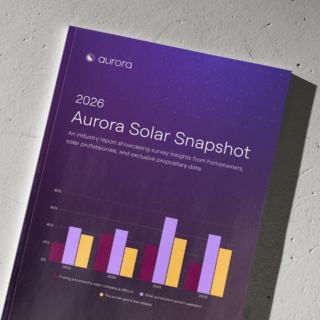
Only 3% of homeowners say they have no interest in battery storage.
Let’s say that again for everyone in the back: Only 3% of homeowners say they have no interest in battery storage.
It’s wild. In the 2026 Aurora Solar Snapshot, 97% of homeowners expressed at least some interest in batteries, and more than 30% of installers expected at least three-quarters of their upcoming deals to include storage. The national residential attach rate hit 40% in April, with markets like California and Arizona running much higher.
This means that in many markets, storage has gone from an add-on to the opening conversation.
That’s the context for our Horizon session on battery storage: New ways to model storage and savings. It brought together Mack Siren (Staff Product Manager, Aurora Solar), Jody Barrington (Senior Director of Engineering, Aurora Solar), and Mike Benanski, who leads development and planning for Tesla’s residential product line across the globe.
The session covers a lot of ground. Here are a few things that jumped out at us. Definitely check out the full session on demand to learn more, and see how you can model storage more accurately in Aurora.
Tesla Bill Optimization
Mike joined to talk about what Aurora and Tesla have been building together, specifically, how they’re using real-world Powerwall performance data to make Aurora’s simulations more accurate. The result is a new bill optimization algorithm that models how a Powerwall actually charges and discharges (looking ahead at electricity rates, not just backward at historical data), then validates that model against Tesla’s own battery optimization software.
In practice, the old approach could tend to undersell the value of a Tesla battery. But by working with Tesla, the simulations can be that much more accurate, adding that much more value to your battery sales. (Bill optimization is rolling out before the end of the year.)
Beyond the Battery: PowerShare, VPPs, and Whole-Home Energy
Beyond bill optimization, the group discussed some other exciting developments in the market, and with Tesla.
Rate complexity
Utilities are making rates more complicated, and Powerwall’s value is increasingly tied to how well it navigates that complexity.
“Europe is a postcard from the future,” Mike explained, “something I think we’ll see a lot more of in the United States over time.”
PowerShare
A few weeks before the session, Tesla expanded PowerShare Home Backup beyond Cybertruck to include Model 3 and Model Y — with a Powerwall. Of course, it’s worth noting that Tesla sells roughly 500,000 vehicles in the US every year. That’s half a million people who now have a reason to call you about home storage.
Virtual power plants at scale
The numbers Mike shares in here are striking. Just a couple of weeks before the session, nearly 100,000 Powerwalls dispatched over 650 megawatts during a California evening peak. “That’s the size of a medium to large natural gas peaker,” Mike says. “It’s a small nuclear plant, if you really think about it.” [head exploding emoji]
In Puerto Rico, a 50-megawatt Powerwall VPP was the marginal resource on the grid, keeping it from browning or blacking out, roughly a dozen times over the summer.
What’s new and what’s coming in Aurora
The session also gives you two product demos, one for Design Mode and one for Sales Mode, walking through the new unified storage workflow. Check them out at the 30-minute mark in the session replay.
Then there’s the product roadmap, what you can expect. (Just a reminder to check in with your rep on exact dates.)
Battery-only retrofits. Nearly 95% of battery-only lease deals are retrofits: existing solar customers adding storage. Right now, running that workflow in Aurora is doable but… less than ideal. What’s coming: A simplified Sales Mode experience where you enter annual production and Aurora handles the rest: savings, battery simulations, financing. No full solar redesign required.
Battery sizing recommendations. Not every sales rep has deep battery knowledge, and they shouldn’t need to. Aurora is working on a recommendation engine that takes project data and hourly load data, runs it through the simulation, and returns a specific battery recommendation with enough detail to have both the technical conversation and the homeowner savings conversation.
Goodbye to Powerwall combo packs. If you’ve been modeling Powerwalls in Aurora, you’re familiar with the workaround: combo packs representing different configurations of units and expansion modules. With the new unified storage workflow, you’ll be able to model components separately, configure quantities, and have everything flow cleanly into the bill of materials.
Watch the Full Session
Want to see the demos, learn more about where the market is headed, and see what Tesla and Aurora are working on? Click below to check out the full session on demand.
Questions? Reach out to your Aurora account team or request a personalized, no pressure demo to learn more.