For years, the residential solar pitch was: Reduce your electricity bill, go green, here’s your payback period. And for years, it largely worked.
But today’s market is different. (Perhaps you’ve heard of The New Shape of Solar?) Utility rates have risen. Grid reliability has declined. EVs are in more driveways.
Homeowners are increasingly aware of how interconnected their energy decisions are and are asking questions that go well beyond solar. What about my EV charger? My HVAC system? My hot water? How do I make this house actually run on clean energy?
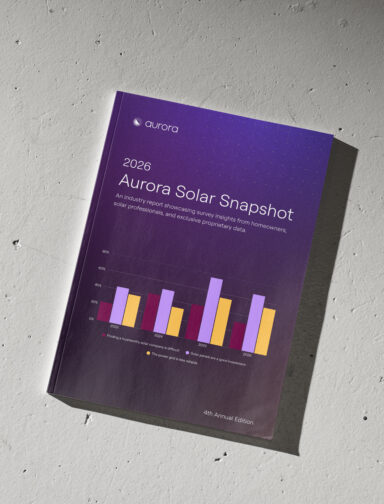
The data from the 2026 Aurora Solar Snapshot is clear: Solar companies are becoming home energy companies, and the sales teams that recognize this shift are capturing more value per customer than those still selling solar as a standalone product.

The home energy product expansion: EV, roofing, HVAC, and more
74% of solar companies already offer additional products beyond solar, or plan to expand further.
The most common additions?
- EV charging equipment and installation, offered by 71% of salespeople who sell additional products
- Roofing (65%)
- HVAC systems (31%)
- Smart thermostats (24%)
- Heat pumps (17%)
For teams thinking about what to add next, the research also captured future intentions. 44% of companies are considering adding EV charging if they don’t already offer it. 38% are considering roofing, 33% are looking at HVAC, and 27% are eyeing smart thermostats.
The pattern is consistent: the products adjacent to solar that make the most sense are the ones that touch energy use most directly. An EV charger increases household electricity consumption — which strengthens the case for solar. A heat pump replaces a gas furnace — which adds to the electrification story. A smart thermostat helps a homeowner understand and manage their energy in ways that complement solar’s value. They’re all natural extensions of the same conversation.
| 💡 Sell whole-home energy upgrades in Aurora: Energy optimizations let reps model how solar, storage, EV chargers, and other efficiency upgrades interact, so homeowners can see the full impact on their energy bill. Learn more about energy optimizations. |
From solar rep to home energy advisor
The data on homeowner interest tells the same story from the other side. When asked what factors influenced increased homeowner interest in solar, 58% of salespeople cited rising utility costs as a significant driver — the strongest signal in the survey. EV adoption was cited by 22% as a significant driver and another 48% as a slight one. Energy storage paired with solar was seen as a significant driver by 34% and a slight driver by 43%.
Together, these numbers describe homeowners who are thinking about their energy consumption as a whole — not just, “Should I get solar?” but, “How do I get ahead of rising utility costs across everything I use electricity for?” A salesperson who can only answer the solar question is leaving part of that conversation on the table.
The frame that resonates with homeowners right now isn’t “solar panel salesperson,” it’s “energy advisor.” The rep who walks in prepared to discuss solar, storage, EV charging, and home efficiency — and who can help a homeowner understand how those pieces fit together — is meeting the customer where they actually are.
The home energy bundling challenge
Of course, this new role comes with some added complexity. Selling a single solar system is a defined workflow: site assessment, design, proposal, financing, contract. Adding roofing, HVAC, and EV charging to that workflow introduces new pricing structures, new equipment categories, new installation partners, and new proposal requirements.
How frequently do salespeople sell additional products alongside solar? Only 7% always bundle them and 32% often do. The most common response (42%) was “sometimes.” And that “sometimes” number is where the opportunity lives. The teams that have figured out how to make bundled proposals seamless — pricing non-solar components clearly, presenting them in a single proposal alongside the solar system — are converting that “sometimes” into “often.”
The challenge of quoting roofing at a per-square-foot price, an EV charger as a fixed installation cost, and solar as a system price — all in one coherent proposal that a homeowner can actually evaluate — is a real one. Teams that solve it have a meaningful edge.
| 💡 Price roofing alongside solar in your proposal: Aurora’s 3D models give you instant access to area data for every roof face, so you can apply square footage-based adders directly in the proposal — no manual calculations needed. Learn more about roof face characteristics and adders and discounts. |
Solar as the start of the home energy relationship
Here’s what the home energy shift ultimately means for sales teams: The customer relationship extends further than a solar install. A homeowner who buys solar today is a potential battery customer next year, a heat pump customer the year after, and an EV charger customer after that — if you’ve built the relationship to support it.
92% of salespeople said their organization has struggled to meet homeowner demand. The market is hard. But the opportunity in home energy is expanding. The teams that are repositioning now — building the skills, the tools, and the product portfolio to serve the full-home energy customer — are investing in a longer-term advantage.
Solar got people in the door. Home energy keeps them there.
This is the final article in Aurora’s 2026 Solar Snapshot series. The full 2026 Solar Snapshot report is available now — with data from 600+ solar sales professionals on storage, financing, competition, closing, and the future of residential energy sales.