Published March 2026 | Based on surveys of 1,112 homeowners and 600+ solar professionals | Aurora Solar proprietary data from 20M+ projects
The New Shape of Solar
The U.S. solar market is at a critical inflection point. After the One Big Beautiful Bill (OBBB) passed last year, and we had the subsequent scramble to sell and install solar systems before the Investment Tax Credit (ITC) for cash and loans (25D) expired at the end of the year, the industry is now navigating a time of extreme volatility and unprecedented shifts. As the market navigates changing federal incentives, the old model of selling solar no longer works. To survive and thrive, the industry must adapt to make residential solar “policy-proof.”
Aurora Solar defines “the new shape of solar” as the industry’s transition toward flexible financing, soft cost reduction, automation and AI, and data transparency following the expiration of federal tax incentives. The Fourth Annual Aurora Solar Snapshot Report dives deep into this new reality. While economic hurdles like “Cost Shock” remain the top barrier to entry, the data makes one thing clear: There is still demand for solar, but it takes hard work and new ways of thinking to translate it into real projects in today’s market. The companies that will lead the next decade of growth are embracing “the new shape of solar” by focusing on flexible financing, soft cost reduction, automation + AI, and data transparency.
Read the report
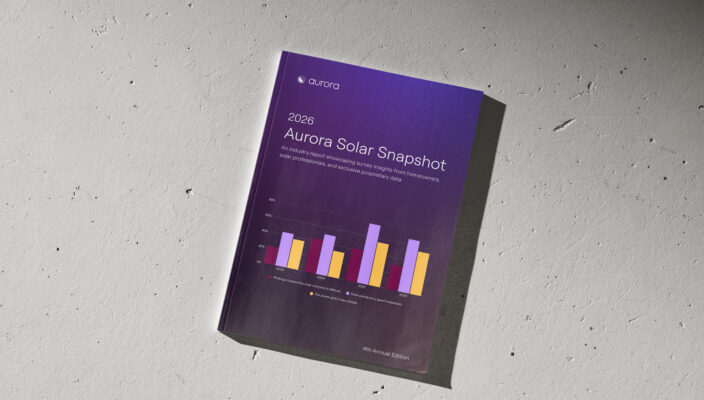
Get access to the full 2026 Aurora Solar Snapshot
Jump to: Homeowner Data, Solar Professional Data, Aurora and HelioScope Data, Sales Professionals Data, Methodology, Frequently Asked Questions
Financing Flexibility: Financing is evolving to combat the high-interest-rate environment, address upfront affordability concerns, and realize the value of incentives for as long as possible. Third-party ownership (TPO) models such as leases, power purchase agreements (PPAs) have grown, and pre-paid TPO options are showing promising interest.
More than half of installers (55%) claim TPO is now their most popular financing option, outpacing traditional loans and cash. With 82% of installers noting that homeowners prioritize their monthly payment amount, future-proofing solar adoption requires empowering homeowners with flexible, integrated financing choices that help them find the option with the highest monthly savings.
Automation and Soft Cost Reduction: While hardware costs have fallen over the years, soft costs are actually increasing: They still make up roughly 40% of all project expenses. This makes it critical to improve efficiency to be able to compete in a less favorable policy environment.
As tax incentives diminish, eliminating inefficiencies like change orders, redesigns, and permitting delays is no longer optional to win customers over, especially since 40% of installers cite permitting and regulatory delays as a top challenge. Homeowners feel this friction, too: 17% say they are worried the installation process will be too long and complex. To win over these buyers and help reduce soft costs, speed and accuracy are paramount. When installers can quickly produce accurate system designs and costs, they can confidently offer guaranteed or fixed-price quotes, a feature 41% of solar shoppers say would motivate them to go solar.
Data Transparency and The “Resilience Stack”: Beyond costs, grid anxiety is driving adoption. Over half of homeowners (53%) explicitly agree that the power grid is less reliable, and installers are capitalizing on this by offering the complete “Resilience Stack” of whole home electrification tools. Currently, 71% of installers offer EV charging equipment alongside solar, and nearly a third (31%) expect more than 75% of their 2026 projects to include battery storage. By demystifying the solar process and proving the ROI, the industry can shift solar from something that is aggressively “sold” to an investment that is confidently “bought.”
Making Solar “Policy-Proof”: Policy remains the ultimate market catalyst. In late 2025, the looming expiration of the 25D section of the Investment Tax Credit (ITC) — for cash and loans — under the federal Inflation Reduction Act (IRA) was a powerful solar accelerator. In fact, 68% of recent solar buyers stated they sped up their installation timelines to beat the expiration deadlines.
Support for solar-friendly policies and solar adoption broadly transcends politics. Republicans and Democrats are almost exactly as likely to have installed solar in the past year, and to be interested in installing in the future. But the industry can no longer wait on Washington or hope that policy will reflect the attitudes of constituents. While the past year was volatile, the underlying demand drivers — rising energy costs, energy security concerns, and surging grid demand — are firmly in place.
We expect 2026 will continue to present uncertainty, with solar organizations working to adapt to Foreign Entity of Concern (FEOC) regulations, new financing options like pre-paid leases, and evolving consumer attitudes towards the industry. Installers who adapt by embracing automation, expanding financing, reducing soft costs, and leading with transparency will be best positioned for the industry’s next phase of growth. The new shape of solar is here, and it starts now.
Homeowner data
Solar motivations, blockers, and opportunities
For the fourth year in a row we surveyed more than 1,000 homeowners to learn more about their intentions, interests, and must-haves when it comes to solar, storage, and home electrification.
Throughout this section of the report we broke down the data into two broad categories:
- Those who have not yet installed solar panels but are interested or started the purchase process
- Those who already installed solar panels
We then look at what the data says is holding people back and offer insights into how to help move them forward.
One thing that’s clear from the data? While it has been a rocky year for installers, solar remains extremely popular among homeowners.
Solar is Universal
At a glance
- 71% of homeowners said they have at least some interest in solar
- 34% of Democrats and 34% of Republicans listed “policy incentives” as a top motivation for going solar
- Utility bill savings was by far the biggest motivator for both Republicans (82%) and Democrats (87%) interested in installing solar
Here’s a quick look at the political affiliation of homeowners interested in solar:
- Democratic (39%)
- Republican (34%)
- Independent (15%)
- Other (6%)
- Not Registered (3%)
Perhaps the most significant finding in our Aurora Solar Snapshot reports over the past few years has been just how positively most people feel about solar (51% in 2024, 76% in 2025, and 78% in 2026). Interest in solar continues to be strong across party lines and across the country. Solar continues to unite people from all different backgrounds: Republican, Democrat, Independent, doesn’t matter. It is overwhelmingly popular across the politics that divide us in almost every other aspect of life.
The motivations for wanting solar are also remarkably similar. Solar continues to be mainly a money saving and energy independence sale. But, as it has been in every year of our research, savings comes first. Likewise, exactly 34% of both Republicans and Democrats said policy incentives were one of their top three motivations for going solar.
Top 3 motivations for going solar
(homeowners interested in solar, but not yet purchased)
| Overall | Independent | Democratic | Republican | |
| Utility bill savings | 87% | 89% | 87% | 82% |
| Energy independence (for backup power during outages) | 72% | 76% | 72% | 74% |
| Reducing my environmental impact | 56% | 50% | 69% | 40% |
| Increase home value | 38% | 30% | 33% | 49% |
| Tax incentives | 37% | 50% | 34% | 34% |
There are some differences, too, of course. When asked to select their single top motivation, Republicans were more likely than Democrats to prioritize energy independence, and Democrats were more likely to prioritize reducing their environmental impact.
Top motivation for going solar
(homeowners interested in solar, but not yet purchased)
| Overall | Independent | Democratic | Republican | |
| Utility bill savings | 45% | 52% | 43% | 41% |
| Energy independence (for backup power during outages) | 21% | 26% | 16% | 27% |
| Reducing my environmental impact | 16% | 4% | 27% | 8% |
| Tax incentives | 10% | 13% | 8% | 10% |
| Increase home value | 8% | 4% | 5% | 13% |
If there’s this broad interest in going solar, why have the past couple of years felt like a slog? Why did we see the capacity of solar installed in 2025 contract by 28% compared to 2024? The market factors are obvious: high interest rates and significant policy shifts. There’s also a more general gap between interest in solar and the decision to purchase solar that remains a sticking point for solar companies. Let’s see what’s stopping people from installing, and then see what we can all do to make it easier for homeowners to say, “Yes.”
Jump to:
The Obstacles
Cost Factors
At a glance
- 43% of homeowners interested in solar said it was more expensive than they initially thought
- 25% of homeowners who purchased said it was more expensive than they initially thought
- 35% of homeowners interested in solar said they were unsure about potential ROI
- 25% of homeowners who purchased said they were unsure about ROI
What’s driving homeowners to explore solar
Among homeowners who are interested in solar, but don’t yet have it, cost is the number one obstacle.
While utility bill savings is the top motivation for wanting solar (cited by 87% in their top three reasons), this isn’t just an abstract thought. Homeowners have expectations when it comes to an investment as big as solar, and since their main motivation is bill savings, installers need to meet them with compelling cost savings and return on investment (ROI) information — both of which are inconsistent right now:
- 44% of people who are interested in solar but haven’t yet purchased said that solar is more expensive than they initially expected.
- 36% are unsure about the potential ROI based specifically on their home’s electricity usage.
When looking specifically at the installation and financing processes, 49% were concerned about high installation and maintenance costs, and 31% pointed to high interest rates.
What homeowners who have solar say
It can be helpful to look at what factored into the decision for those who already have solar, since we know that despite any concerns they eventually did put panels on their roof.
Nearly nine in ten (87%) of those who have solar indicated that one of their top motivators was utility bill savings. But the abstract promise of savings is no longer enough to close the deal. Those committed to purchase still said their top roadblock was the fear that “the upfront cost is too high,” cited by 25%. Another 25% were worried about the specific ROI based on their personal electricity use.
These numbers are noticeably lower than those who are interested in solar but haven’t yet bought. What happened? Presumably, these buyers took the next step in the purchase process because they got information to allay those concerns. We’ll see exactly what that information is in our next section. You can jump right to it here (link).
Cost concerns have consistently dominated the decision-making process when it comes to solar, but homeowners have become more sophisticated shoppers, and now look for a broader range of benefits besides just saving money.
Homeowner Mistrust Remains Elevated
At a glance
- 22% of those interested in solar are worried the installer will go out of business
- 41% of those interested in solar are concerned about trustworthiness of solar companies
- 31% of those who installed solar were concerned about trustworthiness of solar companies
What’s driving homeowners to explore solar
Potential solar customers are highly skeptical of the solar industry as a whole, and they want safety nets and unbiased information before signing on the dotted line.
- Their top concerns regarding the installation process are warranty and general maintenance (41%) and the trustworthiness of solar companies (36%). 23% are worried whether the installer will remain in business at all.
- When deciding on an installer, they overwhelmingly demand protection: 67% say strong warranties and support services are the most important factor, alongside positive customer reviews (54%) and technical expertise (54%). They also heavily value verified installer reviews (49%).
But the data reveals a critical nuance: The lack of trust is mainly on the financial side, not the technical. Homeowners generally trust that installers know how to put panels on a roof; their skepticism focuses squarely on the sales pitch, the complex financing options, and ROI promises.
When shopping for solar, financial and pricing concerns dominate homeowner fears: 49% are concerned that installation and maintenance costs are too high and 31% are worried about high interest rates. To bridge this trust gap, financial transparency is non-negotiable. When asked what would make them more likely to install solar today, the top responses were entirely financial:
- 46% want “Clear visibility of the total upfront costs and expected savings on [my] energy bills”
- 36% want “Confidence that [they are] getting a fair price”
- 36% want “Clear information about the long-term return on investment”
What homeowners who have solar say
Those who already have solar installed had similar qualms. Confidence in installers remains essential. With solar being a major financial decision, homeowners were looking for “confidence signals” to mitigate risk:
- Trust Issues Persist: Among those actively shopping for solar, 36% cite the trustworthiness of solar companies as a top concern regarding the installation process, and 41% are concerned about warranties and maintenance.
- Business Stability Concerns: Uncertainty about whether an installer will remain in business rose significantly this year, jumping from 11% in 2025 to 19% in 2026.
Trust in solar companies continues to be a roadblock for homeowners, although the specific reasons behind this trust gap have shifted. Fear of scams — is this installer legit, or just someone trying to play me? — has eased somewhat, with a fear of installers going out of business during these uncertain times growing.
The Generational Divide and the “Real Estate Trap”
While high costs and trust issues remain the top reported barriers to going solar, cross-referencing our homeowner data with national real estate trends reveals a massive, hidden bottleneck for the solar industry: The generations most eager to adopt solar are the ones least able to buy homes. When we break down solar adoption by age, the generational divide is stark:
- Younger homeowners are adopting rapidly: Among respondents who own their homes, Gen Z and Millennials are driving the market. A massive 27% of Gen Z homeowners and 18% of Millennial homeowners installed solar in the past year. Furthermore, 12% of Gen Z and 13% of Millennials are currently in the process of purchasing a system.
- Older generations are holding out: Conversely, nearly half of Baby Boomers and the Silent Generation (46%) admit they have “not considered solar” at all. Only 2% of Boomers installed solar in the past year.
If younger generations are so hungry for solar, why is the market contracting? Because in the United States owning a roof is usually a prerequisite for going solar — and younger generations increasingly find themselves locked out of the housing market.
According to the National Association of Realtors (NAR) 2025 Home Buyers and Sellers Generational Trends report, Baby Boomers officially overtook Millennials as the top generation of home buyers, surging to represent 42% of all home buyers. Meanwhile, Millennial home buying dropped notably to just 29%. Furthermore, Boomers represented 53% of sellers — often downsizing to smaller homes or assisted living and buying their new properties in cash, effectively hoarding the available real estate.
This creates a frustrating “real estate trap” for solar professionals. The homes are currently held by the older demographic least interested in adopting solar, while massive “pent-up demand” sits with younger generations who cannot afford to buy homes.
What we can do about it
To capture this eager, younger demographic, the industry must look beyond the traditional single-family rooftop model. As the real estate market remains gridlocked, community solar, solar subscriptions, and emerging alternative technologies like “balcony solar” will become critical release valves to unlock the massive pent-up demand of Gen Z and Millennial renters.
Policy Sensitivity
At a glance
- 49% of those interested think they won’t be able to afford solar without the Inflation Reduction Act (IRA) solar federal tax credits (25D)
- 68% of those with panels say they benefitted from the IRA
- 68% who installed in the past year moved their timeline forward to take advantage of IRA
What’s driving homeowners to explore solar
Despite cost being their biggest barrier, many homeowners are largely unaware of the policy incentives that are still available, indicating a major educational opportunity for installers.
- Nearly half (47%) of solar-engaged homeowners are familiar with how recent changes to the IRA affect home energy tax credits.
- However, a quarter (25%) of the general population admits they “don’t know what the IRA is / what these tax credits are” at all.
- Even among those who already installed or are currently purchasing solar, confusion remains high: 43% are uncertain about how they could have benefitted from the IRA now that many of the credits expired.
The bottom line? Almost half of homeowners (49%) think they won’t be able to afford solar without the IRA’s solar tax credit benefits. This is the perfect time to repeat that third-party ownership (TPO) options like pre-paid leases can still give them all the benefits of ownership, and still qualify for the 30% (up to 40% in some cases!) tax credit. The third-party owner claims the actual credit, but that savings can help drive homeowner costs down.
And a quick, related, note to Congress: 53% of solar-engaged homeowners do not support the repeal of the IRA residential solar tax credits (25D) and believe they should be reinstated.
What homeowners who have solar say
For those who already purchased solar, federal incentives weren’t just a “nice to have”; they were a make-or-break factor for affordability and a massive driver of urgency. Among homeowners who already installed solar or are currently in the process, nearly seven in ten (68%) say they benefited from IRA tax credits. What’s more, nearly 70% of those who installed in the past year explicitly said they moved their timeline forward specifically to beat the expiration deadline.
Homeowner familiarity with the Inflation Reduction Act (IRA) has been a rollercoaster since its inception in 2022. But the One Big Beautiful Bill (OBBB) (we didn’t name it) and impending expiration of the IRA’s benefits put it back in the spotlight — creating urgency and accelerating timelines. (Note that the 2022 numbers are from the 2023 survey, 2023 numbers are from 2024 survey, etc.)
What Can We Do About It?
Provide Multiple Financing Options
At a glance
- 40% interested in solar say different financing options is a factor when considering an installer
- 31% of homeowners are paying with cash
- 20% are choosing TPO
- Almost 40% of those interested in solar don’t know how they’ll finance yet.
- 72% of homeowners want clear “estimated savings from monthly bills,” outranking “financing comparisons” (45%)
Given the affordability and policy concerns, it should come as no surprise that offering flexible financing options is an important part of winning business. Among homeowners still shopping for solar, 40% say the availability of different financing options is a top factor when selecting an installer. For people who already have solar, 31% said having financing options was critical.
Before we get into the most crucial part of landing the deal, it is important to note: The solar industry has been anticipating a rise in third-party ownership (TPO). And it’s diversifying even further with products like pre-paid leases. The overarching takeaway is clear: More financial options equals more sales.
It’s interesting to note a gap in the data: Homeowners consistently report lower adoption of TPO than installers. This points to a need for more education on how financing options differ. Based solely on this data, it would appear that a significant group of homeowners are confused about what type of financing they’re using or considering.
But there’s something even more important than the actual financing behind their solar install…
The Deal-Makers: Monthly Savings, Transparency, and Confidence
Much like how car shoppers may care more about the monthly payment than the actual cost of the car, or home buyers may focus more on their monthly mortgage payment, when asked about what information was important when purchasing solar panels, the highest percentage of homeowners (72%) chose “estimated savings from monthly bills.” While offering diverse financing options is clearly an important part of the solar sale, it’s not the nitty-gritty details of each option that stick with a customer – it’s how solar can affect their monthly budget.
To turn “cost-shocked” holdouts into 2026 buyers, installers must show that solar can deliver savings, and do so for the long term. The data shows homeowners want to know their investment is safe, through warranties, verified reviews, and technical expertise.
Show the savings
When asked what information is most valuable during the shopping process, an overwhelming 72% of active shoppers want clear “estimated savings from monthly bills.” Furthermore, to get homeowners off the fence now that 25D expired, visibility into upfront costs and expected savings (46%), and clear information about long-term ROI (36%) were also important.
Build trust
Whether homeowners’ skepticism is about the actual installer or the financing behind the project, installers are still on the hook to prove their trustworthiness. After all, you’re the face they see at closing and you’re likely the first call when they have a question.
But, how do you prove you’re worthy of their trust? When selecting an installer, homeowners prioritize three trust signals over everything else:
- Strong Warranties: Cited by 67% of interested buyers.
- Technical Expertise: Cited by 54% of interested buyers.
- Verified Reviews: Cited by 54% of interested buyers.
Installers have to actively demonstrate credibility, not assume they have it when engaging with a potential customer.
The Evolution of Trust
Four years of data reveal why homeowners today demand strict financial transparency and rock-solid warranties: Their expectations are the result of a historical trust deficit colliding with rising costs. In 2023, half of homeowners (50%) said it was difficult to determine which solar contractors were legitimate. While that concern eased slightly to 43% in 2024, cost anxiety surged dramatically during the same period, rising from 56% to 75%.
As prices and financing complexity increased, homeowners became more cautious about making a major investment. By 2025 and 2026, that caution evolved into a demand for proof: Cost-sensitive buyers no longer respond to financing pitches alone. Instead, they want clear, verifiable evidence that their investment will pay off, including transparent pricing, reliable savings projections, and protections that ensure the system will deliver ROI.
The Takeaway for Installers: Financing makes solar possible, but transparency and warranties make it trustworthy. Installers who use accurate system design and financial modeling to clearly demonstrate expected savings — and back that system up with strong warranties and verified local expertise — will be the ones who successfully overcome the industry’s financial trust gap.
Lastly, while we have your attention: Homeowners want to see side-by-side, well-explained options to help ease anxiety surrounding costs and rates:
45% of shoppers say that having clear “financing comparisons” is one of the three most valuable pieces of information they could receive when shopping for a system.
Solar Adjacent
There are a couple technologies we asked about that relate to solar and are now part of the sale.
The Dual Case For Battery Storage
We’ve seen that solar is both a resilience purchase and a cost savings one. Which brings us to storage.
Climate change and an aging grid are fundamentally shifting what homeowners are buying. Solar is no longer seen as just a financial tool; it can be a critical home protection upgrade. Let’s walk through how we got here, and what we can do to make solar + storage the default purchase.
Climate and Grid Anxiety is Real
Sixty-two percent of homeowners in our study agree that extreme weather events and climate change are currently impacting their area. Additionally, 53% agree that the power grid has become less reliable.
Grid and climate anxiety and worries about grid stability and extreme weather have grown from a niche concern into the mainstream over the last three years.
The Value of Resilience
This anxiety is directly translating into buyer motivation. Among homeowners who already have solar, 46% cite “energy independence (less reliance on the utility grid)” as a top-three reason they bought their system, and 36% specifically point to “backup power / resilience during outages”.
For those potentially interested in solar, the desire to cut the cord is even stronger: Almost three-quarters (72%) of homeowners who are either in the process of buying or interested in solar include energy independence in their top three reasons for buying.
The Battery Boom
In part because of these grid concerns, interest in home backup batteries is near-universal. Only 3% of solar-engaged homeowners (those who have already installed, are interested in, or are considering solar) say they are not interested in energy storage. Yet only 17% of homeowners in our study own a backup battery, and another 28% are actively considering adding one. So, there is still room for market education.
The Dual Value of Storage — Saving Money
Net metering, time-of-use rates, and variable export rates have made battery storage a purchase that can deliver real savings to customers as well. In many areas, the time of day that you consume electricity is an important part of your energy costs. Batteries give homeowners the option to shift their grid usage to times when power is cheap, using stored electricity from the battery, or even exporting power from the battery to the grid when export rates are highest.
Homeowners are coming around to this thinking. When asked about the most valuable benefits of energy storage, the most popular response was reducing energy bills (65%).
The Adoption Hurdle
If homeowners clearly see the dual-value of pocketbook savings (65%) and outage protection (55%), why isn’t energy storage attached to every single solar project? The data shows it comes down to lingering cost and technology anxiety.
Despite near-universal interest in storage, buyers are hesitating at the finish line because they view batteries as a financial risk. A significant 55% of solar-engaged homeowners agree the current cost of solar batteries is simply too high. Even more telling, 69% are concerned about the battery’s lifespan and future replacement costs.
To bridge this gap and get homeowners off the fence, the sales conversation needs to address these fears head on by leading with long-term warranty protections and demonstrating a reliable, mathematically sound ROI over the life of the system.
Electrification
Currently, very few homeowners own advanced home electrification technology: Only 17% have a home backup battery, 12% have an EV, and 21% have a heat pump. However, their future intent is strong.
- 28% are considering adding a backup battery
- 26% are considering upgrading their electrical panel
- 22% are considering an EV
- 18% are considering a heat pump
We appear to still be in the early adopter phase of whole home electrification in the U.S., but homeowners see the value of whole home electrification paired with solar.
It is also apparent that homeowners are being prudent and addressing electrification one step at a time: first, solar panels, then perhaps upgrading their electrical panel, then buying an electric vehicle, and so on. For the seller, there is an opportunity to help guide homeowners through the whole home electrification journey and to present options they can adopt in pieces.
Want an easier way to overcome the “Cost” and “Trust” objections at the kitchen table?
Download our special homeowner-facing chapter: The 2026 Homeowner’s Guide to Solar: Why Your Neighbors Are Upgrading (And How You Can, Too).
Solar professional data
Solar Professionals Reflect on the Market: Outlook for 2026
The solar community navigated a complex landscape over the last year. While customer demand remained, macroeconomic factors heavily influenced project timelines. Looking back at the biggest challenges in meeting homeowner demand, 44% of installers cited increased short-term equipment costs, closely followed by policy and incentive uncertainty (43%), and permitting/regulatory delays (40%).
Despite these hurdles, the industry is rapidly adapting. Installers are winning deals by building trust: 49% say they win deals over competitors due to better reputation and reviews, and 48% point to a better customer experience. In this section, we explore the strategies installers are using for 2026 — from shifting financing models to product diversification — to keep the market growing.
The IRA & Policy Impact: The End-of-Year Scramble
Financing and government incentives continue to dictate the solar sales process. The Inflation Reduction Act (IRA) has been a massive driver of recent market velocity, and its expiration is viewed as a significant threat to the industry.
- The Demand Surge: 62% of installers reported seeing increased interest in solar from homeowners specifically due to the IRA.
- The Tax Credit Cliff: 63% of installers believe the passage of the OBBB (repealing the solar tax credits for homeowners) will have a negative impact on their business (27% predicting a significant negative impact).
- Homeowner Awareness Drives Action: Unlike in past years where installers felt homeowners were in the dark, awareness translated to urgency. A massive 45% of installers noted they saw increased demand from homeowners specifically trying to take advantage of IRA benefits by the end of 2025.
But it’s not all bad news. While the 30% tax credit ended for solar loans and cash purchases for homeowners, it is still in effect for third-party owners. And solar companies are making sure they, as well as their customers, are getting the most out of it. With options like pre-paid leases with the option to buy, homeowners can even get the cost benefits of TPO with the overall benefit of owning the system long-term.
The Financing Shift: TPO Takes the Crown
As we saw in the homeowner data, high interest rates created a “Cost Shock” that makes affordability the top hurdle. From the installer perspective, overall project costs are the number one reason homeowners back out of committing to a project (21%), followed by uncertainty around future policy or incentives (15%).
To combat this, the industry aggressively pivoted toward third-party ownership (TPO) models like leases, pre-paid leases, and power purchase agreements (PPAs) to remove the upfront cost barrier.
- TPO is Now the Most Popular Product: 55% of installers say TPO is their most popular financing option, surpassing traditional loans (17%) and cash (16%).
- Widespread Adoption: 73% of installers adopted a TPO strategy specifically to serve homeowners who cannot purchase solar upfront. Currently, 78% of installers offer TPO, while 76% offer cash, and 71% offer loans.
- The Monthly Payment Rules All: When choosing financing, 82% of installers say customers prioritize the monthly payment amount — well ahead of overall savings (49%) and interest rates (27%).
- Looking Ahead to 2026: TPO will dominate in the short-term. 65% of installers anticipate that more than half of their entire 2026 sales volume will use TPO products.
Energy Resilience and “The Resilience Stack”
Grid anxiety continues to be a major motivator for homeowners, and installers are capitalizing on this by attaching more storage and home energy upgrades to their sales.
- Outages Drive Storage: Installers indicated the primary motivations for homeowners purchasing battery storage are backup power and protection from outages (56%), far outpacing energy independence (21%) or maximizing bill savings (19%).
- High Attach Rates: Storage is becoming a standard part of pitches and proposals. Looking ahead to 2026, 31% of installers expect that over 75% of their projects will include battery storage.
- Diversifying Beyond Solar: Installers are expanding their offerings to capture more business beyond just panels on roofs. Beyond solar and storage, 71% of installers now offer EV charging equipment and installation and 65% offer roofing services. Looking forward, 33% are considering offering home HVAC systems and 27% are looking into smart thermostats and home energy controls.
- Future Tech: When asked what technological advancements they are most excited about, 51% pointed to next-generation solar panels, followed by smart inverters (41%), whole-home electrification (37%), and EV charging integration (37%).
Market Education Opportunity
Those who read the Homeowner section of this report closely will notice that what homeowners reported about their storage interest differs quite a bit from what installers said here.
Nearly three in ten (28%) homeowners indicated they are considering battery storage. There is potential, though: Just 3% of homeowners interested in solar said they specifically were not interested in battery storage.
And when asked about the most valuable benefits of energy storage, the most popular response was reducing energy bills (65%).
This uncovers a couple opportunities.
First, installers assuming that homeowners are mainly looking at storage for resilience may be able to pivot to a money-saving pitch based on the homeowner’s situation.
Second, with just over a quarter of homeowners actively considering storage, but very few specifically not interested, there is a very clear market education opportunity. Homeowners are open to storage, and showing them the potential dual value — especially in areas prone to outages or with time-of-use (TOU) and variable export rates — can lead to higher attachment rates.
And finally, there’s a real opportunity to show homeowners how solar fits in with whole home electrification possibilities. This is still developing, but — as discussed in the homeowner section of this report — homeowners show increased interest in upgrading to electric, including:
- 28% considering adding a backup battery (valuing them primarily for reduced energy bills and resilience during outages).
- 26% considering upgrading their electrical panel
- 22% considering an EV
- 18% considering a heat pump
Want to learn more insights directly from solar sales professionals? This year we surveyed over 600 sales pros to see what they’re experiencing and how they plan to sell in 2026. Jump to it here.
Aurora and HelioScope data
Aurora residential and HelioScope commercial trends in system size and price per watt (PPW)
The U.S. solar market faced headwinds in 2025 as high interest rates and policy uncertainty weighed on distributed solar demand. Residential installations declined year-over-year in several quarters, even as utility-scale projects continued to drive overall capacity growth.
This pullback was heavily driven by “Cost Shock,” high interest rates, and both the uncertainty caused by OBBB legislation and the impacts of the bill itself. However, there is a silver lining: Despite the uptick in costs due to FEOC and other factors, hardware costs continue to drop generally, creating immense opportunities for solar professionals to package system savings with high-demand battery storage to win deals in 2026.
Below is an analysis of the trends from Aurora’s residential and HelioScope’s commercial design data, highlighting where the market is shifting.
Aurora residential solar trends: System size and PPW shifts
- Median Residential System Size: 7.92 kW in 2025 (-6.49% YoY) Homeowners are opting for smaller system sizes, which fell from a median of 8.47 kW in 2024 to 7.92 kW in 2025. This aligns with homeowner sentiment data showing that overall installation cost is the number one roadblock to adoption.
- National Median PPW: $3.44/W in 2025 (-14.21% YoY) Prices fell sharply across the country, dropping from $4.01/W in 2024 to $3.44/W in 2025. This steep 14% drop reflects significant reductions in hardware and panel costs, giving installers crucial breathing room when designing systems for budget-conscious homeowners.
The 2025 “One Big Beautiful Bill” Scramble
To illustrate the market volatility surrounding the July 2025 legislation, we analyzed the quarter-over-quarter (QoQ) momentum in key regions. By tracking the velocity of residential solar designs, the data reveals a massive “pull-forward” effect: Homeowners rushed to finalize projects ahead of the bill’s passage, leading to a severe market exhaustion by the end of the year.
- The Anticipation Surge (Q2 2025): As the bill gained momentum in the spring, we saw a significant scramble to initiate projects before the bill passed. For example: the East North Central* division experienced a massive +50.04% QoQ surge in Q2, while the California market saw a steady +8.85% QoQ increase.
- The Q3 Plateau: During the quarter that the bill passed (Q3/July), design volume remained near those Q2 peaks as the final scrambling homeowners locked in their credits. Markets experienced only a minor cooling effect, dropping just -5.83% in California and -5.85% in the East North Central region.
- The Q4 “Cliff” (The Aftermath): Following the summer rush, the active pipeline largely exhausted itself. Once the mid-year scramble was over and the new reality set in, project counts fell. This resulted in QoQ project drop-offs in Q4:
- East North Central: Project volume fell by -61.81% in Q4.
- California: Project volume plummeted -39.75% in Q4.
*Illinois, Indiana, Michigan, Ohio, and Wisconsin
Opportunities for Residential Solar Installers
- Leverage Lower PPW to Sell the “Resilience Stack”: System sizes may be shrinking, but grid anxiety is surging. With 53% of homeowners saying the grid is less reliable and 42% of active shoppers wanting backup storage — and 77% of installers reporting that the primary drivers for purchasing storage are protection from outages and energy independence — installers have a timely opening to bundle solar + storage without blowing up the budget. The economics can work both ways: Adding storage can improve the overall PPW story, and smaller solar systems can free up budget headroom to include a battery — making resiliency easier to say “yes” to. It’s a win-win.
- Offer “Quartered Market” Financing Comparisons: The market is perfectly split between cash, solar loans, bank loans, and leases. Installers who provide clear, side-by-side financing comparisons — and explicitly show how the remaining 48E section of the IRA tax credit makes the system affordable — will win the trust of cost-shocked buyers.
- Look for Regional Outliers: While the national PPW dropped 14%, prices in the West remained flat at $4.00/W. Meanwhile, emerging markets like Puerto Rico saw project counts surge by over 51%, driven by grid reliability needs. Incentives differ wildly between states, so it’s important to highlight where your state can offer support.
HelioScope commercial solar trends: System size and PPW shifts
- Median Commercial System Size: 340.32 kW in 2025 (Virtually Flat YoY): Unlike the residential sector, commercial system sizes remained mostly stable, shifting less than 1% from 342.35 kW in 2024 to 340.32 kW in 2025.
- National Median PPW: $2.17/W in 2025 (-4.62% YoY) Commercial PPW saw a steady decline, dropping from $2.28/W in 2024 down to $2.17/W in 2025.
Opportunities for Commercial and Industrial Solar Installers
- Capitalize on Distributed C&I Stability: While large utility-scale or massive PPA projects grab the headlines, HelioScope project data shows consistent activity in the sub-350 kW distributed commercial segment. This long tail of smaller rooftop projects represents steady demand across commercial and industrial customers.
- Use Falling Installed Costs to Counter Higher Rates: A nearly 5% decline in commercial PPW helps offset some of the pressure from higher financing costs. Installers can highlight how lower installed costs improve returns and can shorten payback, especially when paired with strong rate economics and disciplined execution.
- Financial Solutions Remain the Differentiator: Just like in the residential sector, commercial installers who adapt their strategies — focusing on flexible financing, tax credit maximization, and clear energy cost savings — will be best positioned in the year ahead.
Bonus: Sales Professionals Data
What’s happening in the field — and how to adapt
The solar sale is evolving.
And nobody knows this more than the people on the ground: sales professionals. To get a better understanding of the solar industry, from the people who know it best, we surveyed more than 600 sales professionals across the country to uncover insights into how teams are adapting to the new shape of solar — and where the biggest opportunities lie.
In this special chapter of the 2026 Aurora Solar Snapshot we look specifically at sales teams: what they’re anticipating for the next year and how they’re adapting their strategies to succeed.
There’s no sugar coating the fact that 2025 was a tough year for installers. Nearly half of installers (46%) reported a decline in sales volume in 2025, while 54% say competition intensified over the past year. At the same time, the opportunity in residential energy is changing — across storage, financing models, and whole-home upgrades. In this section we look at each of these opportunities in detail to see how the best sales teams are succeeding as the solar coaster rolls on.
Storage Is Expanding Across Retrofits, Standalone, and More
Storage has become a core part of the residential energy conversation. It’s not just an add-on anymore; in many markets it’s a primary demand driver.
- High and Rising Attachment: This year, 65% of salespeople anticipate at least 25% of their projects will include storage, up from 57% last year. While 31% expect storage attachment on at least 75% of their projects, up from 27% last year.
- Growth Beyond New Installs: 72% report that at least some of their storage projects are retrofits or add-ons to existing systems, and 47% say they are selling at least some battery-only systems without solar.
- Resilience is Key: As we mentioned previously, installers cited backup power as the primary homeowner motivation for storage (56%), followed by energy independence (21%) and maximizing bill savings (19%).
- Regional Variation in Demand: Storage attachment rates are significantly higher in Western markets like California, where batteries are approaching default inclusion and maximizing bill savings plays a larger role in homeowner motivation. In outage-prone regions like the South and Northeast, resilience remains the dominant driver.
Storage now spans multiple sales motions — solar-plus-storage, retrofits, and standalone systems — and the right approach depends heavily on geography, policy, and homeowner priorities. Sales teams that can model and present different storage scenarios based on what makes the most sense for each market and each home are best positioned to capture this expanding opportunity.
Financing Flexibility is the New Standard
Financing continues to shape the sales landscape, often determining whether a project moves forward at all. As affordability remains top of mind for homeowners, how the system is financed is increasingly as important as the system itself.
The data shows clear momentum towards third-party ownership (TPO) models — alongside growing adoption of alternative structures:
- TPO Acceleration: While 44% of salespeople reported more than half of their projects used TPO in 2025, they anticipate that figure will rise to 65% for 2026. Meanwhile, salespeople not selling TPO drop from 9% in 2025 to just 1% in 2026.
- Multiple Options Are the Norm: 63% offer cash, loan, and TPO, signaling that many salespeople recognize the need to provide multiple financing pathways rather than rely on a single structure.
- Prepaid is Gaining Ground: 45% of salespeople now offer prepaid TPO and 11% say it’s the most popular financing option among homeowners, reflecting growing interest in financing options that combine upfront predictability with long-term value.
- Affordability Drives Decisions: Monthly payment amount remains the top priority for homeowners when choosing a finance option (82%), followed by overall savings (49%) and interest rate (27%). This reinforces the importance of offering structures that align with homeowner cash flow priorities.
The key, then, is that the best solar sales pros have to be flexible when it comes to financing options. Homeowner preferences vary. Market conditions vary. Policy landscapes vary. Sales teams that can confidently offer and explain multiple financing options will empower homeowners to make informed, confident decisions — and that confidence leads directly to higher close rates.
Solar Companies Are Becoming Home Energy Companies
The modern sales team is becoming a broader home energy advisor. As storage adoption rises, adjacent products are also entering the sales conversation — creating opportunities to increase value per project and strengthen homeowner relationships.
74% of salespeople either already offer additional products or plan to expand further. The most common additions are:
- EV chargers (71%)
- Roofing (65%)
- HVAC systems (31%)
- Smart thermostats (24%)
- Heat pumps (17%)
Homeowners are thinking more holistically about their energy use. Sales teams that position themselves as advisors — capable of connecting solar, storage, EV charging, and efficiency upgrades — are better positioned to capture this growth.
Competition is Up — and Trust Wins
With 54% reporting increased competition in the past year, differentiation matters more than ever.
When asked why they win deals over competitors, sales reps pointed to:
- Better reputation and reviews (49%)
- Better customer experience (48%)
- Lower pricing (30%)
- Better product quality/equipment (15%)
In a more competitive environment, trust and professionalism outrank price. The way a deal is presented — including the clarity of the proposal, the credibility of the savings estimates, and the accuracy of system design and production numbers — increasingly influences the outcome. As homeowners evaluate more bids, confidence in the numbers and trust in the data become as important as the equipment itself.
Closing is the Bottleneck
With increased competition for fewer installs, the most efficient sales teams win more often. So, it’s critical to identify those bottlenecks in your sales process and find ways to improve them.
Of course, we always want to generate more leads, but we can see there’s a big opportunity to convert existing ones more efficiently. Automation and streamlined workflows play a growing role here. Reducing manual steps, minimizing back-and-forth, standardizing documentation, and moving seamlessly from proposal to agreement help teams maintain momentum.
In a market where every deal matters more, the ability to move quickly — without sacrificing professionalism — becomes a defining edge.
Solar Sales in 2026
The 2026 sales landscape is defined by expansion — of products, financing options, homeowner expectations, and competition.
Storage is becoming foundational. Financing structures are diversifying. Solar companies are evolving into full home energy providers. And efficiency at the point of close is increasingly tied to revenue performance.
The common thread across these shifts is flexibility.
Sales teams that can model different scenarios, offer multiple financing pathways, communicate clearly, and move efficiently from proposal to agreement will have a measurable advantage. Not because the market is easier — but because they are better equipped to navigate it.
Want to keep the Sales Professionals Data section for later?
Download this special chapter for sales pros: Solar Sales Professionals: Everything There is to Learn from Fellow Salespeople in 2026
Methodology
This report was informed by multiple data studies:
Coleman Parkes Homeowner and Business Owner Study
Aurora Solar commissioned Coleman Parkes, an independent market research company, to conduct the research for 2025 and 2026. The survey was employed using an online (CAWI) methodology, ensuring a broad, representative sample of participants.
The 2026 homeowner survey included 1,112 participants across the United States, specifically targeting individuals who have solar panels installed, are in the process of purchasing them, or are open to installing them in the future. This group was selected to ensure responses were relevant to those considering or open to solar energy solutions. The fieldwork for the 2025 homeowner survey was conducted from January 7 to January 10, 2025. The fieldwork for the 2026 survey was conducted from January 19 to January 27, 2026.
Note: There were 1,080 respondents screened out due to lack of home ownership, their property already had solar, or they were not interested in purchasing solar. 209 people were not interested in solar.
The survey was designed to gather comprehensive insights into the current attitudes toward solar energy, with a focus on participants’ willingness to engage with solar solutions. The methodology ensured that only individuals who were not outright dismissive of solar technology were included, offering valuable perspectives on adoption potential.
Dynata Homeowner Survey
Homeowner insights referenced from 2023-2024 for this report were obtained via a survey of 1,000 U.S. adult (18+) homeowners, and was conducted by Dynata in January 2024 and January 2023. The 2023 survey sample included individuals who had rejected solar (i.e., those who expressed no interest in installing solar), while the 2024 survey sample excluded those respondents. As the world’s largest first-party data company, Dynata has a global reach of more than 62 million consumers and business professionals, fully permissioned with billions of verified data points. Dynata uses a variety of online sample sources and recruitment measures to invite its respondents and panelists for survey research participation.
Aurora Solar Proprietary Data Study
Findings pertaining to Aurora Solar’s system size and pricing data examine residential and commercial (C&I) projects created in Aurora and HelioScope between 2024 and 2025. The analysis uses the following parameters:
- Geography and Location: Aurora utilizes state fields to identify project geography, whereas HelioScope relies on exact coordinates. For grouping purposes, the “State Region” field is based on standard U.S. Census Regions, while the “State Division” field relies on a modified version of U.S. Census Divisions.
- Project Size: Looks up the median system size (in kW) of projects designed in Aurora and HelioScope. Since each project may contain multiple designs, only the most recent design is used.
- Project Pricing: Looks up the median price per watt (USD/W) of projects quoted in Aurora and HelioScope. Excludes outliers.
- Note on Residential Definition: A residential project is strictly defined in the dataset as an Aurora project with a system size of less than 50 kW (kW < 50)
Qualtrics Residential Solar Professionals Survey
Residential solar professional insights for this report were obtained via a survey of 600 U.S. solar professionals conducted by Aurora Solar. The online survey was distributed via Qualtrics in February 2026 with built-in quality checks to monitor attention and response time. The target population for this study was defined as U.S.-based professionals actively involved in the residential solar industry, including roles in sales, design, operations, marketing, engineering, installation, and C-suite.
The margin of error is ±4 percentage points at the 95% confidence level.
Frequently Asked Questions
Frequently Asked Questions: 2026 Aurora Solar Snapshot
What is the Aurora Solar Snapshot? The Aurora Solar Snapshot is Aurora Solar’s annual research report on the U.S. solar industry. Now in its fourth year, the report combines homeowner survey data, solar professional survey data, and proprietary project data from Aurora and HelioScope to provide a comprehensive view of solar market trends, adoption barriers, and installer strategies. The 2026 report surveyed 1,112 homeowners and more than 600 solar sales professionals, and analyzed millions of residential and commercial solar projects.
What are homeowners’ biggest concerns about going solar in 2026? According to the 2026 Aurora Solar Snapshot, cost is the leading barrier. 44% of homeowners interested in solar say it is more expensive than they initially expected — a phenomenon Aurora Solar calls “Cost Shock.” The second-largest concern is trust: 41% of homeowners say it is difficult to determine which solar companies are trustworthy. High installation costs (49%) and uncertainty about ROI (36%) round out the top barriers.
What financing method is most popular for solar in 2026? Third-party ownership (TPO) — including leases, power purchase agreements (PPAs), and pre-paid leases — is now the most popular solar financing option according to Aurora Solar’s 2026 research. 55% of installers say TPO is their top product, surpassing traditional loans (17%) and cash (16%). 65% of sales professionals anticipate more than half of their 2026 projects will use TPO.
Is demand for solar still strong despite policy changes? Yes. According to the Aurora Solar Snapshot, 71% of homeowners say they have at least some interest in solar. Support is consistent across political lines — Republicans and Democrats are equally likely to have installed solar in the past year and to be interested in installing in the future.
What is “Cost Shock” in solar? “Cost Shock” is a term coined by Aurora Solar to describe the gap between what homeowners expect solar to cost and what it actually costs. Aurora Solar’s 2026 research found that 44% of homeowners interested in solar say the technology is more expensive than they initially thought, making it the leading barrier to adoption in 2026.
What is the “Resilience Stack”? The “Resilience Stack” is a term used by the 2026 Aurora Solar Snapshot to describe the combination of solar, battery storage, EV charging, and other home electrification technologies that installers are increasingly bundling together. According to the 2026 Aurora Solar Snapshot, grid anxiety is a primary driver of this trend — 53% of homeowners agree the power grid has become less reliable.
What is the “Real Estate Trap” in solar? The “Real Estate Trap” is a term introduced by Aurora Solar in the 2026 Aurora Solar Snapshot to describe the mismatch between solar demand and homeownership. The generations most interested in solar — Gen Z and Millennials — are increasingly locked out of the housing market, while Baby Boomers, who now represent 42% of home buyers, are the least likely to adopt solar.
What does Aurora Solar’s data show about battery storage adoption in 2026? According to the 2026 Aurora Solar Snapshot, storage is becoming a standard part of the solar sale. 31% of installers expect more than 75% of their 2026 projects to include battery storage. Only 3% of solar-engaged homeowners say they are not interested in energy storage, indicating strong latent demand that has not yet converted to purchases.
What happened to solar demand after the IRA’s 25D tax credit expired? Aurora Solar’s 2026 research found that 68% of homeowners who installed solar in the past year moved their timeline forward specifically to beat the expiration of the IRA’s 25D tax credit. Following the mid-year scramble, project volume fell sharply in Q4 — declining 61.81% in the East North Central region and 39.75% in California.