
Will a home battery keep your house running during an outage?
There’s no shortage of options when it comes to keeping the lights on when the power goes out. See why battery backup just might be the best one.
Let’s cut right to the chase: Yes, a home battery can keep your house running when the power goes out… if it’s sized for it. A home battery keeps your essentials running when the grid goes down, and when it’s paired with solar it can keep them going for as long as the sun keeps charging it back.
The rest of the year? Battery storage can even lower your electric bill by banking cheap power for expensive hours.
If you’ve been wondering about this lately, you’re in good company. In the 2026 Aurora Solar Snapshot, 53% of homeowners said the power grid has gotten less reliable, and 62% said extreme weather is affecting their area. What’s more? Only 3% of homeowners had no interest in battery storage.
If you’re in that 97%, here’s how the thing actually works.
How a home battery actually works
A home battery is connected to your electrical panel. When the grid goes down, an automatic transfer switch detects it, disconnects your home from the grid, and switches over to battery power — in milliseconds. Fast enough that your devices don’t notice. Fast enough that you might not notice it either.
Day to day, the battery charges from the grid (usually overnight, when electricity is cheapest), from your solar panels if you have them, or both. When it’s paired with solar and the grid goes out, the panels keep topping the battery off through the day. That’s the difference between a battery with a fixed amount of juice and one that refills while the sun’s out.
You set your preferences once and mostly forget it’s there. The system handles the rest. How long it handles it depends on what you’re running.
How long will a solar battery last?
Depends on what you’re running. A standard home battery, around 13 to 15 kWh, powering just the essentials can last two to three days without solar. Fridge, lights, Wi-Fi, phone charging. Most of what you actually need during an outage draws less power than people expect.
The loads that eat through a battery fast are the big heating and cooling systems: central AC, electric resistance heat, heat pumps. Those pull serious amperage. If any of them are on your must-have list during an outage, that’s a sizing conversation to have with your installer before you buy anything.
Add solar and the whole equation changes. Your panels recharge the battery during the day, even while the grid is down. A well-sized system can carry a household through a multi-day outage without running dry. Knowing how long a battery lasts brings most people to the same question: What does it actually cost?
What does a home battery system cost?
The upfront number is real and there’s no point dancing around it. A whole-home battery system can run from $10,000 to $20,000 installed before incentives, sometimes more depending on capacity and what your electrical setup requires.
When the battery is paired with solar, it works for you on regular days too. Instead of buying electricity at peak rates in the evening, you can use the battery to power your house on what you stored during the afternoon. This can make battery payback periods can be as short as five years, depending on your utility rates, system size, and the incentives available in your area.
Battery-only is also an option. You give up the self-recharging during outages and the daily bill savings, but you get solid outage protection. Most installers can add panels later if you want to go that route down the road. Whether it’s worth the investment depends partly on where you live and how shaky your local grid has gotten.
Is the grid actually getting less reliable?
For a lot of people, yes. Summer electricity demand keeps breaking records, much of the grid is aging, and heat waves and storms are hitting harder than they used to. Homeowners are already reacting: the first quarter of 2026 was the biggest on record for home-battery installations in the U.S., and the fastest growth showed up in hot, storm-prone states. The big challenge of summer is that the grid is shakiest on the exact afternoons everyone wants their AC running full blast.
None of that is a reason to panic. It just means a worry a lot of households share turns out to have a pretty simple answer.
What homeowners actually want from a battery
For a lot of homeowners, battery storage comes down to control. When we asked homeowners and solar installers what was important about storage, the answers were pretty consistent. Solar pros said backup power and outage protection is the number-one reason their customers buy a battery (56%). Homeowners themselves put outage protection (55%) right behind bill reduction (65%) when they ranked what made battery storage appealing to them, and 72% of people interested in solar said energy independence was one of their top three reasons for getting panels on their roof.
So battery storage is way beyond niche. A battery can earn its keep in ordinary weeks by helping you cut out using the grid during peak-rate hours, and it’s there for you when the power goes out.
What a home battery actually powers
A battery doesn’t have to run your whole house. Most people back up their essential items and let the big, occasional loads sit the outage out. That keeps the cost down and the runtime up.
| Usually covered (essentials) | Often skipped or managed during an outage |
| Refrigerator and freezer | Central air conditioning (large draw) |
| Lights and Wi-Fi | Electric oven and range |
| Phone and laptop charging | Clothes dryer |
| Medical devices like a CPAP | EV charging, unless the system is sized for it |
| Sump or well pump | Running everything at once |
Add rooftop solar and things get really interesting. While the grid is straining in the afternoon heat, your panels are near peak output and refilling the battery. That can be the difference between a few hours of backup and potentially getting through a multi-day outage.
A lot of homeowners get to this point and ask whether a generator would just be simpler. It’s a fair question. Generators are generally cheaper upfront, widely available, and easy to understand. For households that lose power once every few years for a few hours at a time, a generator might be enough.
But most people who’ve actually used a generator during an extended outage can tell you where it falls short. Many generators have to be started manually, which means someone has to be home when it happens. The fuel goes stale. The carburetor clogs. It’s loud, it puts out fumes, and it doesn’t do anything for your electricity bill when the power is on. A battery with an automatic transfer switch just turns on, silently, whether you’re home or not. And paired with solar, it’s working for you every day, not just the bad ones.
Home battery vs. gas generator: a quick comparison
Batteries and generators can both back up your critical energy loads. Which one makes sense for you comes down to how often you lose power, how hands-on you want to be, and what you’re willing to spend upfront.
| Home battery | Gas generator | |
| Upfront cost | $10,000 to $20,000+ installed | $500 to $5,000+ depending on size |
| Federal tax credit | Varies | None |
| Turns on automatically | Yes, in milliseconds | Usually requires manual start |
| Runtime | Hours to days; possibly indefinite with solar | Unlimited, as long as you have fuel |
| Fuel or charging | Charges from grid or solar | Requires stored gasoline or propane |
| Noise | Silent | Loud |
| Fumes | None | Yes, must be run outdoors |
| Maintenance | Minimal | Regular upkeep required |
| Works during a multi-day outage | Yes, with solar | Yes, with enough fuel on hand |
| Bill savings between outages | Yes, with solar | No |
The generator wins on upfront cost and unlimited runtime. The battery wins on everything else, especially if you’re not home when the outage happens. Add solar and the battery becomes the stronger long-term option on both resilience and cost.
Try it: Blackout Battle
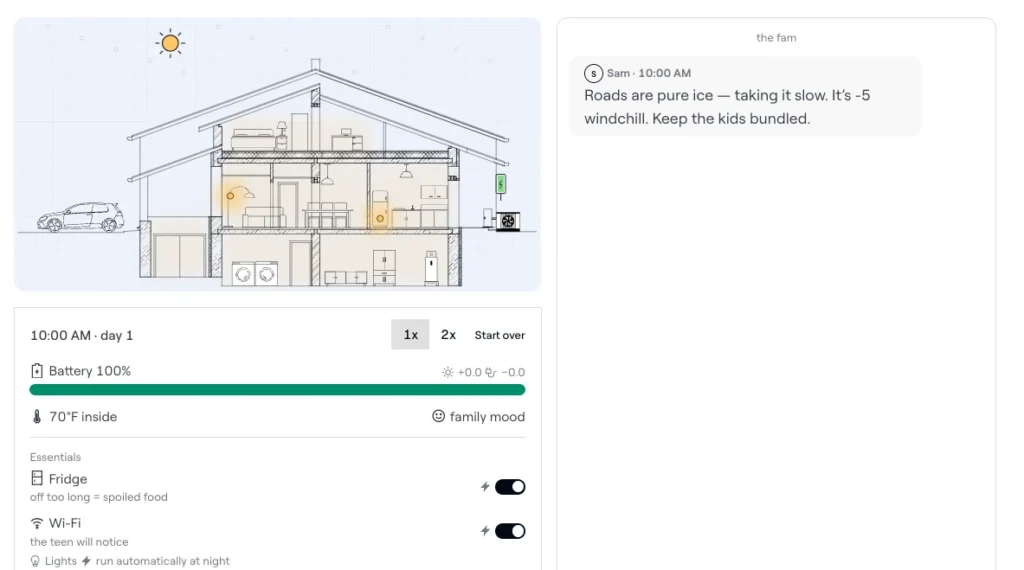
If you want the idea to click, play it out. Blackout Battle cuts the grid at noon and gives you 24 hours to keep your household running. You pick a scenario (the Summertime Storms heat wave might hit particularly close to home these days), set a budget, and outfit your home with some mix of battery, solar, efficiency, and insulation. Your partner and kids text you requests the whole time. It’s a quick, fun way to see how the pieces trade off against each other.
Choosing an installer you can trust
Once you’ve decided whether a battery is worth it, the harder question is who to buy it from. Aurora’s Trust Signal shows that trust is the second-biggest barrier to going solar, behind only cost, even though 71% of homeowners are at least open to solar and 80% consider it a viable, sustainable industry. Reported bad experiences with solar pros have also fallen across our last three surveys.
The homeowners who end up happiest tend to look for the same handful of things:
- Ask for a real install price and a straight answer on when the savings start; 57% say that earns their confidence more than anything else.
- Read the reviews, and check certifications and hands-on experience, which about 54% of homeowners weigh most heavily.
- Lean toward whoever is most transparent about costs and performance data.
You can see what homeowners like you care about in the Trust Signal data, and it’s worth reading up on how to spot a bad actor before you take any sales calls.
When you’re ready, get a no-pressure estimate and see what solar plus storage would look like on your roof.
Data sources: 2026 Aurora Solar Snapshot (Coleman Parkes, n = 1,112 homeowners) and the Aurora Solar Trust Signal Dynata, n ≈ 1,000 per wave). Interactive: Blackout Battle. Essential-load examples are general guidance, not a system-sizing recommendation.