Do Solar Panels Work in Winter? Yes! Here’s what you need to know
You’re in luck, solar panels do produce electricity in winter. There are differences in efficiency and total production, but they do keep generating electricity as long as the sun is shining.
As winter approaches, those of us in the northern United States pull our parkas and boots out from storage, while those in Southern areas get those long-sleeved t’s ready to throw over your short-sleeved t’s.
We also start to get questions about solar in the winter. Does it work? Is it worth it? What do I need to know?
The short answer is: Solar does work in winter. It may produce less total energy, but it can definitely still help with those electric bills. Let’s see what you need to know.

In this article:
- The short answer: yes, and cold helps
- Why cold temperatures improve solar panel efficiency
- What about snow?
- Shorter days: what to expect from winter production
- How winter fits into your annual solar picture
- Frequently asked questions
The short answer: Yes, solar panels work in winter
As you know, solar panels need, well, sunlight. As long as the sun is above the horizon, even on a cold, clear day in the depths of January, your panels produce electricity.
A few things worth knowing upfront:
- Cold air makes panels more efficient, not less (more on this below)
- Snow can temporarily cover panels, but it usually slides off pretty quickly
- Shorter winter days definitely reduce total production
- Germany, with cloudier skies and higher latitude than most of the U.S., is one of the world’s top solar nations
So, please don’t stop reading, but in conclusion, solar panels do work in the winter. Keep going to learn how well and what to expect.
For more on how panels handle cloudy days and nighttime, see: Do solar panels work on cloudy days or at night?
Why cold temperatures improve solar panel efficiency
In fact, solar panels are more efficient in cold temperatures. Now, that doesn’t mean you’ll generate more total electricity in the winter, but it’s just an interesting fact (we think so, anyway), that helps bump your production a bit when it’s cold. Here’s why:
- Solar panels are tested and rated at Standard Test Conditions (STC): 77 degrees fahrenheit (25 celsius)
- For every degree above 25°C, most panels lose 0.3%–0.5% of their rated output (the “temperature coefficient,” listed on every panel’s spec sheet)
- On a hot summer day, panel surface temperatures can reach 65°C+ (almost 150°F!), meaning output may be 12–20% below their rated value
What this means in winter:
- At 0°C (32°F), most panels produce more than their STC rating
- A bright, cold January day can actually outperform a hazy 90°F August afternoon in terms of electrical output per hour of sun
Summer generates more total energy because of longer days, higher sun angle, and more sun hours, not because heat helps. Cold, clear winter days with direct sun can be efficient production days on a per-hour basis. It’s not enough to make up for the amount of daylight or the angle of the sun, but it does help.
What about snow?
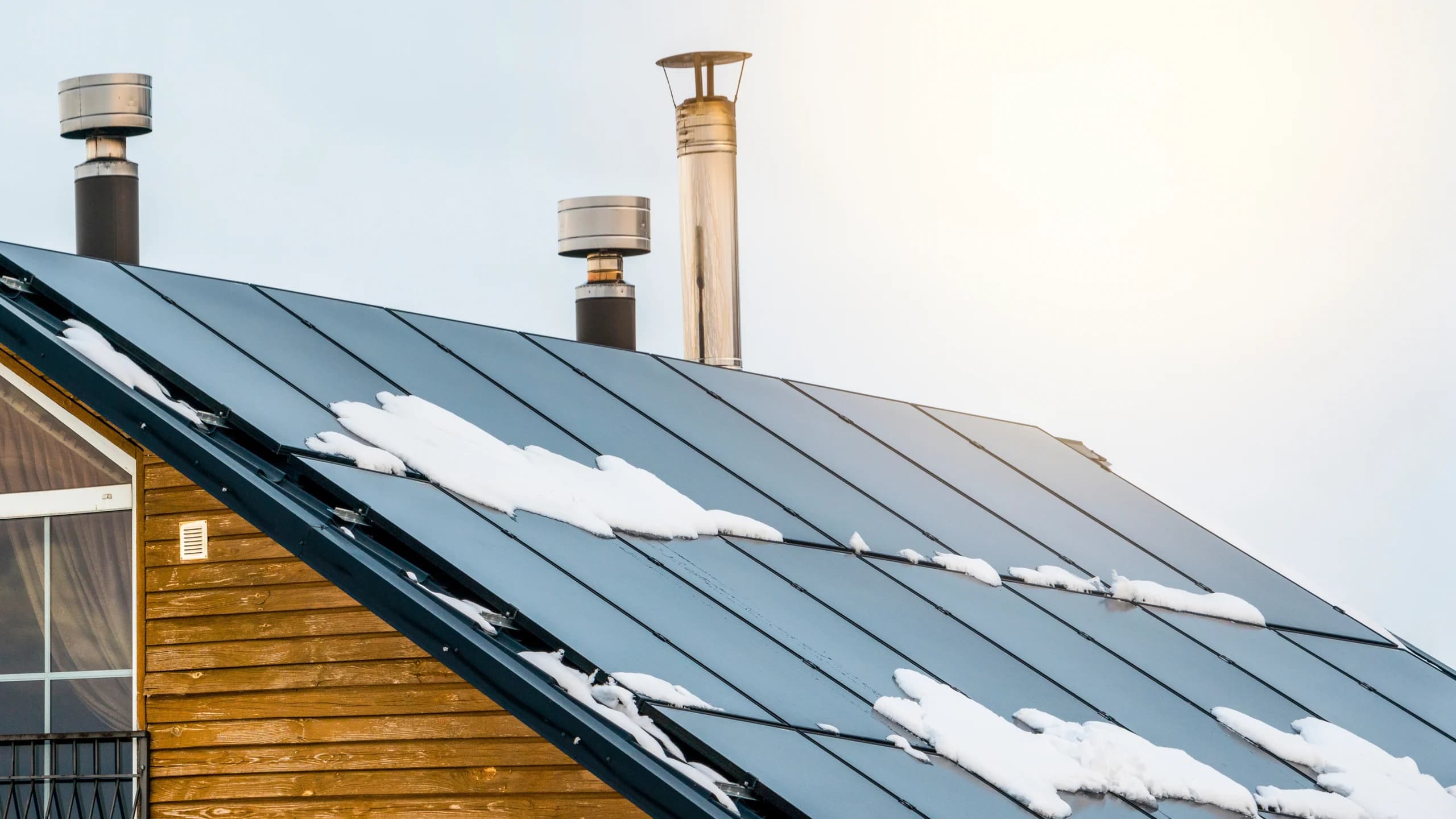
For those of us who get snow, there’s no doubt it can be an issue. Snow covered panels, after all, don’t produce (much) electricity. The good news is that it’s temporary. Modern panels are mounted at an angle, and their dark surface absorbs heat, helping snow slide off faster than you’d expect. Light snow and frost often melt off within hours on a sunny day.
Fresh snow on the ground around your home can even increase your panels’ output by reflecting additional diffuse light onto the panel surface (called the “albedo effect” if you’re fancy).
The bottom line? In most U.S. snow climates, snow-related production loss over a full year is minor, typically 1–5% of annual output
Should you brush snow off your panels?
No. We’re going to list some facts in a bulleted list below. But please just never do this.
- It’s usually not worth the risk. Panels are mounted on roofs, and falls cause injuries
- Most installers recommend letting the panels clear naturally
- Knocking or scraping panels can damage the panel surface
Again, please don’t do this.
Shorter days: What to expect from winter production
There’s no way around it: Shorter days mean less solar production.
Let’s take a look at the typical seasonal output for a solar system in the Northern Hemisphere:
- Peak production: May–August (long days, direct sun angle)
- Winter months (December–February): 40–60% of peak monthly production, depending on latitude and local weather. Still producing every day the sun is out, just fewer hours
As we mentioned previously, it’s not just that there’s less daylight. The sun angle is also lower. Solar panels are typically installed at a fixed tilt on your roof. The exact angle largely depends on your roof’s slope.
In winter, when the sun is lower in the sky, it really depends on the angle of the panels. For example, south-facing panels on a steep roof may actually capture sunlight more directly than in summer. On shallower roof pitches, it won’t be as efficient.
How winter fits into your annual solar picture
The thing is, a solar system will be sized and priced based on your annual energy needs, not just the sunny months. And depending on your state’s net metering policies, you may be able to save the value of that excess summer production to use against your bill in the winter. (See how in our Net Metering 101 post.)
Let’s take a look at how:
- Installers pull your 12-month utility bill and design a system to offset as much of your annual usage as is practical, and is allowed by regulations (often 80–100%)
- Summer overproduction can earn net metering credits
- Winter underproduction can draw those credits down
- Over the full year, a well-sized and well-designed system hits its target, even in cold climates
Just be sure you ask your installer about their process. Questions like, “What’s the estimated monthly production for each month of the year?” and, “How does my utility’s net metering policy handle the summer-to-winter credit carry?” are critical. Any good installer will be able to answer them, and show you a nice production and consumption graph. These questions will also signal that you’re serious and know what you’re talking about.
There’s really no way around it, solar production varies by location. All things equal, a home in Phoenix is going to generate more annual electricity than one in Boston.
But “more” and “enough to save you serious money” are not the same thing. Add in net metering policies, and solar can be a great investment no matter how cold and dark your winters feel. An installer can show you exactly what your roof and location would produce, before you commit to anything.
So, don’t let winter get you down. While you’re huddled under a weighted blanket drinking hot chocolate, or putting a light wind breaker over your t-shirt depending where you live, your panels will be producing electricity and saving you money.
Get a no-pressure estimate — see your 12-month production, sized for your home and location.
Frequently asked questions
Do solar panels work in cold weather?
Yes! They actually work more efficiently in cold weather than in heat. Solar panels lose roughly 0.3%–0.5% of output per degree Celsius above 25°C (77°F). On a cold, clear winter day, your panels can outperform a hazy, hot summer afternoon on a per-hour basis.
Do solar panels work when it’s snowing?
Not well during heavy snow accumulation, panels under thick snow produce little. But they typically clear on their own within hours to a day on a sunny winter day, and light snow and frost often melt off quickly. Snow-related annual production loss in most U.S. climates is minor, typically 1–5%.
Q: Do solar panels work in winter in cold states like Minnesota or Massachusetts?
Yes. Massachusetts has one of the highest residential solar adoption rates in the U.S., and Minnesota’s solar market has grown significantly. Germany, which is farther north than all of the contiguous U.S. and has a cloudier climate, is one of the world’s top solar nations. Latitude and cold winters don’t disqualify a location for solar.
Q: How much does solar production drop in winter?
A good rule of thumb for most U.S. locations is that December and January production is roughly 40–60% of peak summer production. The shorter days and lower sun angle are the primary drivers. A well-designed system accounts for this — summer overproduction banks net metering credits that offset winter shortfalls.
Should I wait until summer to go solar?
No. Installation timelines typically run 2–4 months from signed contract to activation. Starting the process now means your system could be producing by spring, and you’re not paying utility rates through the winter while waiting. The economics of solar are based on annual production, not the season you install.
Q: Do solar panels need direct sunlight or just daylight?
They produce best under direct sunlight, but they generate electricity under diffuse daylight too. On an overcast winter day, output is reduced but not zero — typically 10–25% of what a clear day would produce, depending on cloud thickness.
See our full breakdown of cloudy-day and nighttime performance →