Do You Actually Need to Clean Your Solar Panels?
For most U.S. homeowners, rain handles routine dust well enough — but bird droppings, heavy pollen, and dry climates are a different story. Here’s how to know if your panels actually need attention, and what to do if they do.
If you’ve wondered whether the layer of pollen, or worse, on your solar panels is quietly costing you money, you’re not alone. It’s one of the most common questions solar homeowners have — and the honest answer is: probably less than you think, but it depends on where you live and what’s on your panels.
Here’s what the research shows, and how to tell if your system needs help.
In this article:
- Does dirt actually reduce solar output?
- Does rain take care of it?
- When cleaning actually matters
- How to know if your panels need cleaning
- What to do if they do
- What not to do
- Frequently asked questions
Does dirt actually reduce solar output?
Yes — but the amount varies a lot based on the kind of soiling you’re dealing with and where you live.
For most U.S. homeowners in average climates, routine dust and light particulate accumulation causes roughly 1–5% output loss under normal conditions. According to the National Renewable Energy Laboratory (NREL), annual soiling losses reach as high as 7% in some parts of the U.S. — but that’s toward the high end, and it’s concentrated in specific regions and conditions.
The bigger variables are what’s on your panels, not just whether they’re dirty:
Dust and light particulate. The baseline soiling in most areas. Rain removes it reasonably well, and the losses are modest in typical U.S. climates.
Pollen. A more stubborn problem than most people expect. NREL researchers studied five utility-scale solar plants in North Carolina — a pretty rainy state — and found that pollen reduced panel performance by up to 15% during peak pollen season. Even more striking: performance didn’t fully recover after pollen season ended, despite frequent rain. Without manual cleaning, annual losses from pollen alone were on the order of 10%.
Bird droppings. The worst offender on a per-square-inch basis. Unlike dust, bird droppings don’t just reduce output proportionally — they can create “hot spots” by blocking individual solar cells and causing disproportionate performance loss across the whole panel. And unlike dust or pollen, they don’t rinse off in rain once they’ve dried and baked on.
Smog and industrial residue. Carbon-based particles from vehicle exhaust and industrial sources are a small fraction of overall soiling (roughly 8% of particulate by composition) but are disproportionately effective at blocking sunlight. Homes near busy highways or industrial areas may see higher-than-typical losses.
Already have solar and want to see if adding battery storage is worthwhile? Get an estimate for your home and see what local installers recommend for your area.
Does rain take care of it?
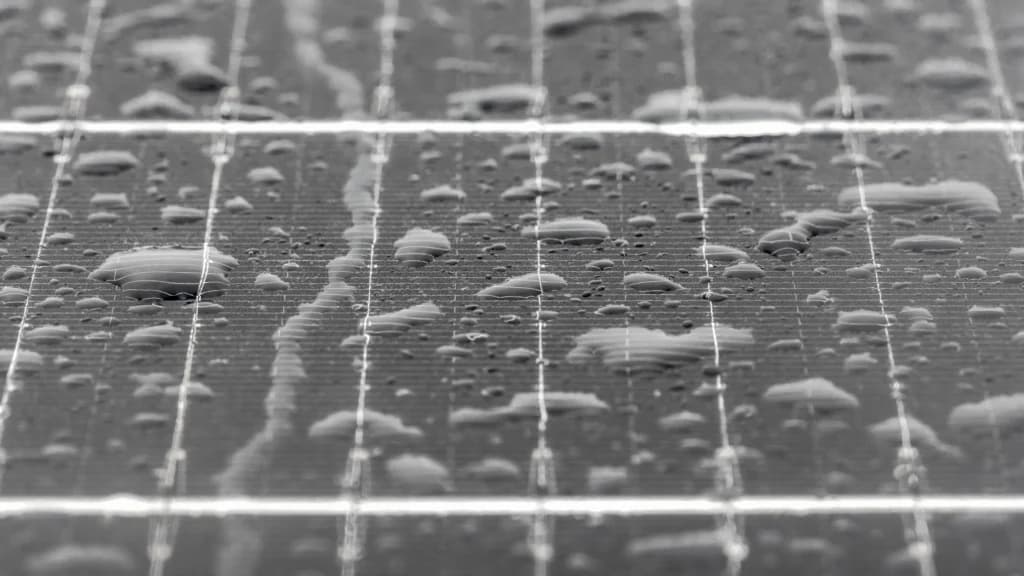
Rain does a pretty good job of washing panels in most areas. In climates with regular rainfall, light soiling gets washed away often enough that the losses stay manageable without any intervention.
For example, the panels on one New England house (OK, it’s mine) were installed in 2022 and have never been washed. Production has stayed relatively steady at around 4.7 MW per year, with no noticeable decline other than the expected aging.
It can be a different story for pollen and bird droppings, though.
NREL’s pollen research made this clear even in rainy climates. Once pollen mixes with dew and minerals on the panel surface, it can undergo what researchers call “cementation” — it physically bonds to the glass and resists rain. Bird droppings dry and harden quickly, especially in summer heat, and become resistant to water once baked on.
So: If all you’re dealing with is dust and your area gets regular rain, you may not need to do anything. But if you’re in a high-pollen region (particularly the Southeast), a dry climate (the Southwest, California’s Central Valley), or you’ve noticed bird activity around your panels, rain alone won’t cut it.
When cleaning actually matters
Location is the single biggest predictor of whether cleaning makes a meaningful economic difference.
Dry climates (Southwest, California’s Central Valley). Infrequent rain means soiling can accumulate faster and stays longer. NREL specifically calls out California’s Central Valley as a region where cleaning more than once a year can make economic sense. If you’re in Arizona, Nevada, New Mexico, or parts of Southern California, planned annual or semi-annual cleaning is worth considering.
High-pollen regions (Southeast U.S.). The NREL pollen study focused on North Carolina solar plants that went uncleaned for over seven years. After a single professional cleaning, output increased by 5–11%. Even in rainy climates, pollen is sticky enough to require occasional manual cleaning in spring or early summer — after pollen season peaks. Again, this isn’t a study of homes, but you can see how it translates.
Bird activity. If you’re seeing significant bird traffic near or over your roof — or if you can see droppings from the ground — this is the one case where the panel location doesn’t really matter. Bird droppings need to come off, and they need professional cleaning to do it safely.
Near construction or heavy dust sources. If your panels were installed during nearby construction, or if you live near agricultural fields, quarries, or unpaved roads, soiling accumulates faster.
How to know if your panels actually need cleaning
You don’t need to get close to your panels to know if something’s off. The best way to monitor your system is through the monitoring app that came with it — most modern inverters and battery systems include one.
Here’s what to look for:
Watch for unexpected output drops. Your system’s monitoring app shows daily and monthly production. A gradual decline in output on clear, sunny days — compared to the same period in prior years — is a signal worth investigating. Many apps will also flag if production is meaningfully below expected levels.
Compare sunny days. If production is noticeably lower on clear days than it was the same time last year, soiling (or a system issue) may be the cause. Soiling alone typically causes a gradual, consistent decline — a sudden drop usually points to something else, like a failed inverter or wiring issue.
Use binoculars or check from the ground. You don’t need to get on your roof. On a sunny day, look at your panels from ground level or an upstairs window. You can see heavy soiling, visible droppings, and obvious debris without climbing anything.
If you notice a meaningful output drop and can’t explain it otherwise, it’s worth a call to your installer or a solar monitoring professional.
What to do if they do need cleaning
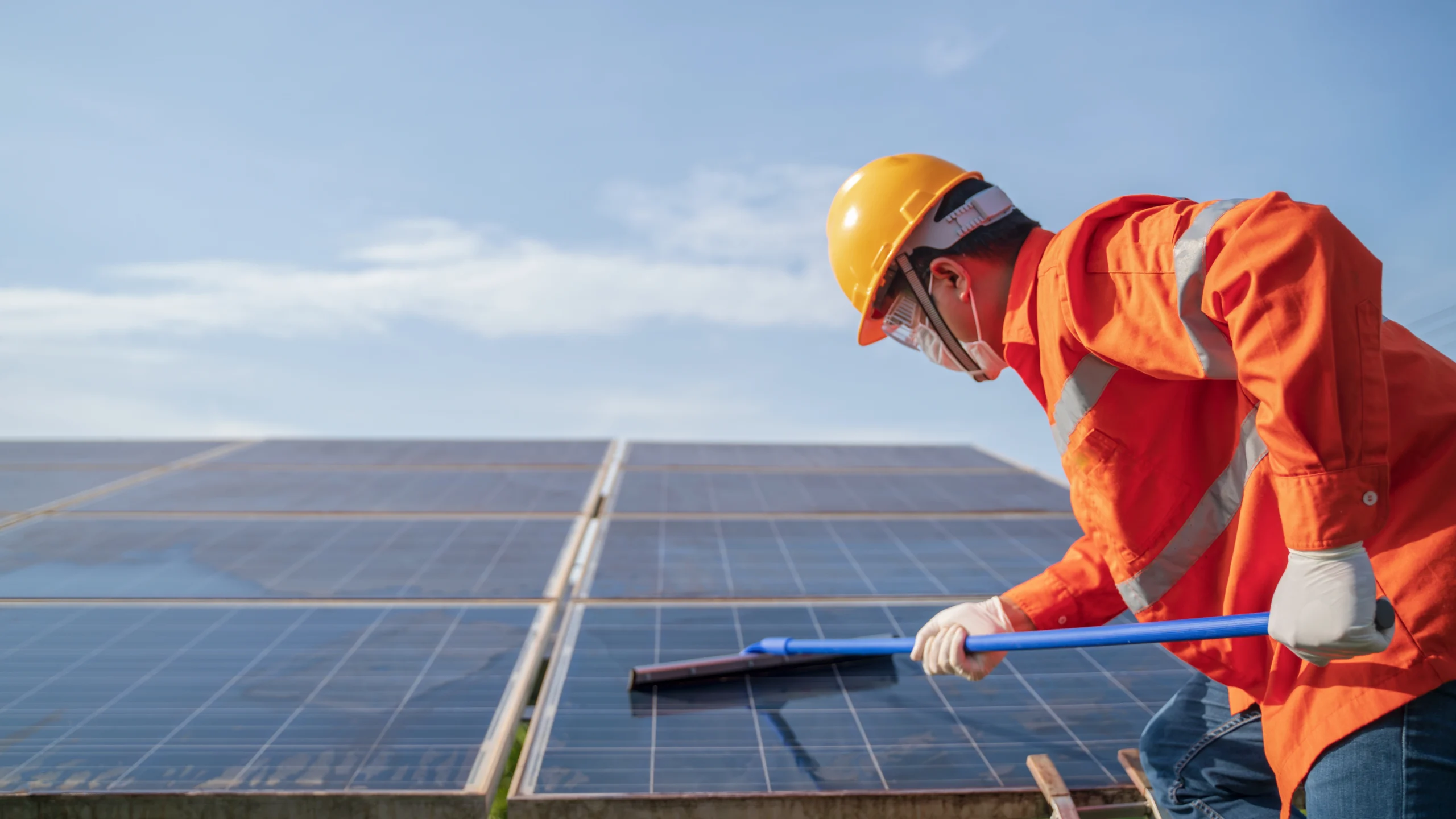
Hire a professional. This is the right call for most homeowners. Professional solar panel cleaning typically costs $150–$350 for a standard residential system, with some services pricing at $10–$20 per panel. If you go with an annual contract covering two visits, you can often get a discount.
Want to find a local pro? Get a solar maintenance estimate with just your zip code — it only takes a minute.
Professional cleaners use purified water systems and soft brushes specifically designed for solar panels — they won’t leave mineral residue or scratch the anti-reflective coating. Many also use extendable pole systems that allow them to clean without getting on the roof, which is both safer and gentler on the system.
If you want to clean from the ground yourself, some panel manufacturers allow rinsing with a standard garden hose at low pressure — but only if you can reach the panels without climbing. Check your panel’s manufacturer guidelines first, since warranty terms vary. Never use a pressure washer, abrasive materials, or soap with surfactants, which can leave residue and damage coatings.
When to schedule it: If you’re in the Southeast, aim for late spring — after peak pollen season. If you’re in a dry climate, fall or early winter (before the dry season kicks in) is a common timing choice. For bird droppings, whenever you notice them.
What not to do
Please don’t do these things, especially the first one.
Don’t get on your roof. Roof falls are one of the most common home injury causes, and solar panels add slip risk. There is no cleaning outcome worth that risk. If your panels need cleaning, hire someone with the right equipment and insurance to do it.
Don’t scrub with abrasive materials. Steel wool, rough sponges, or anything scratchy will damage the anti-reflective coating that helps your panels capture light. Once that coating is scratched, you can’t undo it.
Don’t use a pressure washer. The force can damage panels, push water under the frame, and potentially void your warranty.
Don’t assume cleaning is the problem. Before spending money on cleaning, check your monitoring app. A sudden output drop could be a system issue (inverter, wiring, a shaded string). Gradual decline over weeks is more consistent with soiling.
The bottom line
For most homeowners in rainy climates with light dust accumulation: rain is handling it, and you don’t need to do much. Keep an eye on your monitoring app, and if you notice a meaningful, unexplained output drop on clear days, investigate it.
If you’re in a dry climate, a high-pollen region, or you’ve got bird droppings on your panels — that’s when scheduled professional cleaning is worth the cost. One visit can recover 5–11% of lost output, which adds up over a full year of production.
The main thing to do is keep an eye on what your system is actually producing, and take action if something looks off.
Want to add a battery to your solar system? Get an estimate for your home and see what local installers recommend for your area.
Frequently asked questions
Q: Do you need to clean solar panels?
For most homeowners in climates with regular rainfall, routine dust is managed adequately by rain. The exceptions are dry climates (like the Southwest), high-pollen regions (particularly the Southeast), and homes with significant bird activity. In those cases, professional cleaning once or twice a year can recover meaningful lost output.
Q: How often should solar panels be cleaned?
It depends on your location. In dry climates or areas with heavy soiling, once or twice per year is common. In rainy climates with light dust, many homeowners go years without professional cleaning. The best guide is your monitoring app — watch for gradual output declines on clear days, which can signal soiling buildup.
Q: Does rain clean solar panels?
Rain does a reasonable job of washing off routine dust in most climates. But NREL research found that rain is not sufficient to remove pollen — even in areas with frequent rainfall — because pollen can stick to the panel surface and resist water. Bird droppings also don’t wash off in rain once they’ve dried.
Q: What happens if you don’t clean solar panels?
Output gradually decreases as soiling accumulates. In typical U.S. conditions, the annual loss from soiling is modest (often 1–5%). In dry climates, pollen-heavy regions, or with bird droppings, losses can reach 10–15% without cleaning. Routine monitoring of your system’s production data is the best way to catch meaningful losses early.
Q: Can I clean my solar panels myself?
Manufacturers sometimes allow gentle rinsing with a garden hose at low pressure — but only from the ground, and only if your panels are reachable without climbing. Check your panel manufacturer’s guidelines before attempting anything, as warranty terms vary. Never use a pressure washer, abrasive materials, or soap. For anything beyond a light rinse, hire a professional — they have the right equipment to clean safely without damaging your panels.
Q: How much does solar panel cleaning cost?
Professional solar panel cleaning typically costs $150–$350 for a standard residential system, or $10–$20 per panel. Many companies offer annual maintenance contracts covering two visits per year, which often reduce the per-visit cost by 15–20%. Given that a single cleaning can recover 5–11% of lost output in affected systems, it often pays for itself within a year.