How a solar battery actually works
A curious homeowner’s guide to what’s happening inside the box.
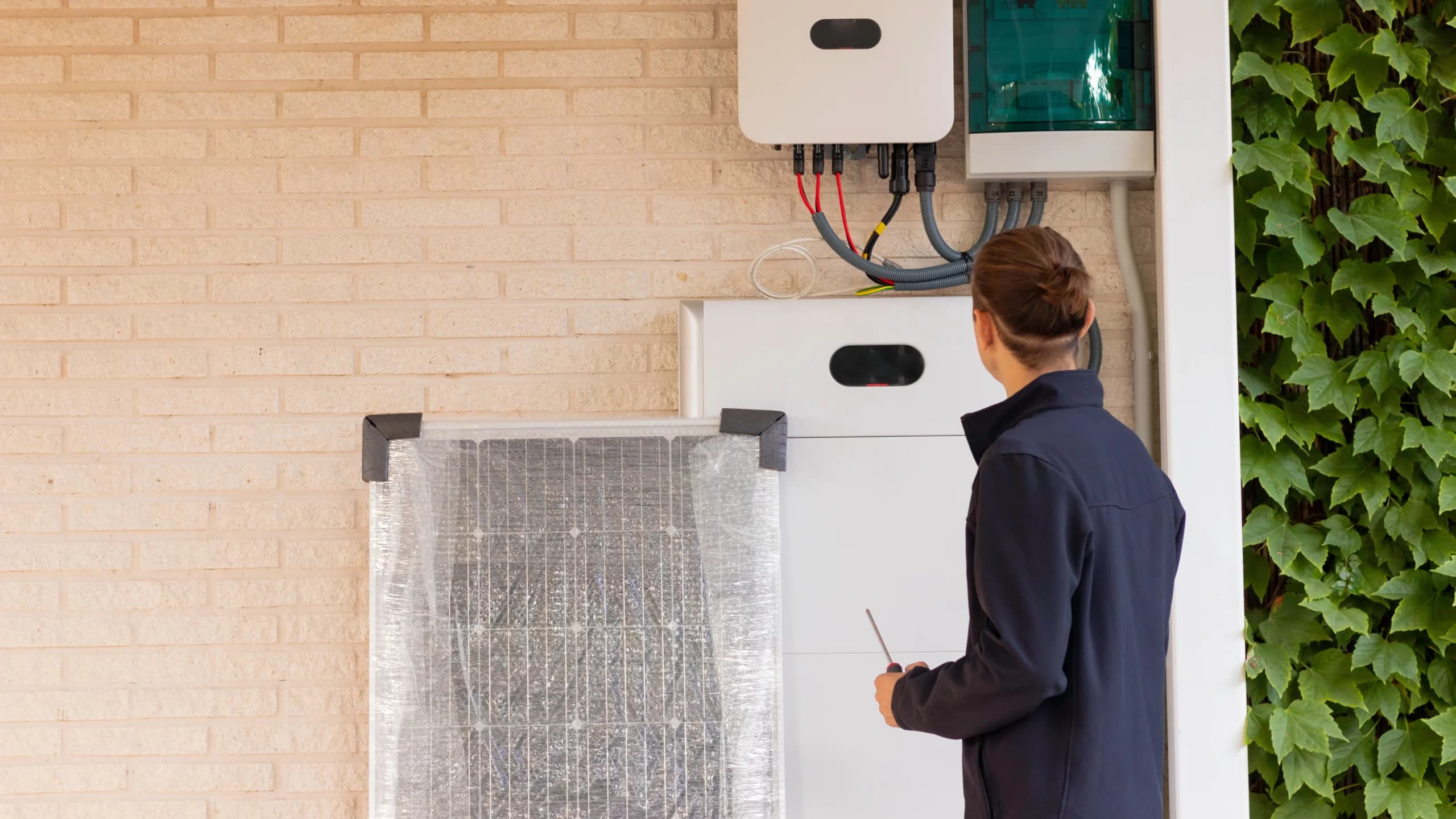
Solar batteries have gotten a lot of attention lately, and a lot of marketing terms to go with it. “Seamless backup.” “Energy independence.” “Store your solar.” But if you’ve ever wondered what’s actually happening inside that rectangular box on your garage wall, you’re in luck.
We’ll get into the chemistry, the hardware, and the day-to-day logic of how a battery works alongside your solar panels — without turning it into an engineering lecture.
TL;DR
A battery stores electricity as chemical energy and releases it on demand. A home battery is surprisingly similar to other batteries you use every day.
What’s inside: lithium iron phosphate (LFP)
Most home solar batteries installed today use lithium-ion chemistry — and within that category, the most popular choice now is lithium iron phosphate, or LFP.
LFP has become so popular for a few reasons:
- It doesn’t overheat. LFP is more stable at high temperatures, which means a much lower risk of thermal runaway — a rare failure where a battery gets hot, gets hotter, and eventually catches fire.
- It lasts longer. LFP can handle more charge-discharge cycles before its capacity meaningfully degrades.
- It’s gotten less expensive. Manufacturing scale, mostly driven by the EV industry, has brought LFP costs down dramatically over the last decade.
What’s actually happening inside a cell
A lithium-ion battery cell has three main components: an anode (negative electrode), a cathode (positive electrode), and an electrolyte separating them. This is true whether you’re talking about home battery storage, or the two eight AAA batteries it takes to power your kid’s remote control car.
When you charge the battery, an electrical current pushes lithium ions from the cathode through the electrolyte to the anode, where they get stored. When you discharge — when the battery is powering your home — those ions flow back the other way, and that movement generates the electrical current your appliances run on.
In LFP specifically, the cathode is made of lithium iron phosphate. The iron-phosphate bond is what makes the chemistry so stable. It takes significantly more energy to break down than other cathode materials, which is why LFP runs cooler and lasts longer.
One cell doesn’t produce much power on its own — typically around 3.2 volts. A home battery is made of many cells wired together to reach the voltage and capacity you actually need.
How your battery connects to the rest of the system
Your solar panels generate DC (direct current) electricity. Your home runs on AC (alternating current). A battery stores DC. Getting all of this to work together is the job of the inverter — and where it sits in the system determines whether you have an AC-coupled or DC-coupled setup.
DC-coupled
In a DC-coupled system, the solar panels feed directly into the battery (via a charge controller), and a single inverter handles the conversion from DC to AC for your home. Because the electricity only gets converted once, DC coupling is slightly more efficient — you lose less energy in the process.
AC-coupled
In an AC-coupled system, the panels have their own inverter that converts DC to AC immediately. The battery then has a separate inverter that converts AC back to DC for storage, and back to AC again when it discharges. Two conversions instead of one means slightly more energy lost, but AC-coupled systems are often easier to retrofit onto an existing solar installation, since you’re not touching the original setup.
For most homeowners, the difference is modest. What matters more is that the equipment is sized and configured correctly for your home’s load and your panels’ output.
The charge/discharge cycle day-to-day
Here’s what a typical day looks like for a solar-plus-battery system:
Morning: Your panels start generating as the sun rises. If the battery isn’t full, it starts charging. Your home’s loads run on solar first; anything extra goes to the battery.
Midday: Peak production. The battery fills up. Once it’s full, any surplus gets exported to the grid (in most setups) or simply curtailed if export isn’t available.
Late afternoon: Production starts dropping. The battery management system (BMS) — more on that in a moment — starts routing battery power to the home instead.
Evening: Panels are done for the day. Your home runs on stored battery power until it’s depleted or you go to sleep, whichever comes first.
Overnight / next morning: If the battery depleted before sunrise, the home draws from the grid. At sunrise, the cycle starts again.
The battery management system (BMS)
The BMS is the brain of the battery. It monitors voltage, current, and temperature across every cell group in real time, and it makes the decisions: how fast to charge, when to stop, when to start discharging, and when to protect the battery by throttling or cutting off power entirely.
The BMS is also what enforces depth-of-discharge limits and prevents the kind of overcharging or deep-discharging that would shorten the battery’s life.
What limits how much you can actually use
If a battery is rated at 13.5 kWh, does that mean you can use all 13.5 kWh? Usually not quite.
There are two numbers worth knowing:
- Nameplate capacity: The total energy the battery can theoretically store.
- Usable capacity: The amount you can actually draw before the BMS cuts off discharge to protect the cells.
The difference comes down to depth of discharge (DoD). Most modern home batteries are rated at 90–100% DoD, meaning the usable and nameplate numbers are close but not identical. A battery rated at 13.5 kWh usable is giving you most of what’s there.
Why not just use every last bit? Repeatedly draining lithium-ion cells completely to zero degrades them faster. The BMS keeps a small reserve to protect long-term lifespan — the same reason your phone battery technically still has a few percent “left” when it shuts itself off.
Why batteries degrade (and how slowly)
Every time a battery charges and discharges, it goes through one cycle. Over thousands of cycles, the chemistry gradually changes — the electrodes wear slightly, the electrolyte breaks down in small ways — and the battery holds a little less than it used to.
A few factors affect how quickly this happens:
- Cycle depth. Shallower cycles (charging from 20% to 80%, say, rather than 0% to 100%) are gentler on the cells. The BMS manages this automatically.
- Temperature. Heat is the enemy of battery longevity. Batteries stored and operated in extreme heat degrade faster. This is worth thinking about if you live somewhere very hot and are deciding where to install.
- Charge rate. Fast-charging puts more stress on cells than slow charging. Home batteries typically charge at moderate rates that balance speed with longevity.
Most quality home batteries carry a 10- to 15-year warranty, and manufacturers typically guarantee they’ll retain at least 70–80% of their original capacity over that period. In practice, a well-managed LFP battery in normal conditions often lasts longer. “Degradation” sounds scary, but losing 20% of capacity over a decade — going from 13.5 kWh to around 10.8 kWh usable — is a gradual and manageable change, not a cliff.
The bottom line
A home battery is a very large, very carefully managed lithium-ion cell stack. It charges when your panels are producing more than you need, and discharges when you need it. The chemistry (LFP) is chosen for safety and longevity. The BMS keeps everything within safe limits. And the inverter handles the translation between DC and AC that makes it all work with your home.
Ready to go deeper? Check out our full guide: Solar energy storage in 2026: everything you need to know — covering cost, financing, what to ask installers, and whether a battery makes sense for your situation.